Course · AICP
ICS AI for Healthcare Professionals
Leadership | Management | Medical Diagnostics
UK Qualification
Practical AI skills for clinical practice, healthcare leadership, management, medical diagnostics, research and AI-enabled professional workflows.

26 Weeks
Programme length
66
Contact Hours
12 UK Credits
Credit-bearing
Self-Paced + Live
Online learning with live sessions
Level 7 Pathway
Not itself a Level 7 qualification
Early Bird Special — First 50 Students
Regular Fee:
Rs. 140,000/-
Early Bird Fee:
Rs. 75,000/-
Save
Rs. 65,000/-
Limited to the first 50 students who complete payment and formal enrolment. Early Bird eligibility is confirmed by the admissions team.
Course overview
A practical course on artificial intelligence for healthcare professionals: 66 contact hours across 10 modules, studied through self-paced online learning with live sessions, with support in English, Urdu and local languages where the platform supports them. The course is a progression pathway to Level 7; it is not itself a Level 7 qualification.
- Build AI literacy specifically for medical professionals.
- Use Generative AI for defined clinical, educational, research and administrative tasks.
- Develop structured medical prompt-engineering skills.
- Apply AI to clinical reasoning support, documentation, research, patient education and workflow improvement.
- Understand AI in medical imaging, laboratory diagnostics and clinical decision support.
- Interpret basic diagnostic-AI performance measures.
- Identify hallucinations, bias, automation bias, false positives and false negatives.
- Protect patient confidentiality and recognise cybersecurity risks.
- Design safe AI-assisted workflows with human verification.
- Develop an AI project relevant to the learner's specialty.

Who the course is for
- Medical students
- House officers
- Residents
- General practitioners
- Specialists
- Consultants
- Medical faculty
- Healthcare professionals
Learning structure
10
Modules
66
Contact hours
26 Weeks
Duration
- Interactive teaching / demonstrations~20%
- AI laboratory exercises~35%
- Clinical case simulations~20%
- Specialty workshops~10%
- Capstone project~15%
- Online theory and demonstrations.
- Live virtual AI tool workshops.
- Supervised hands-on laboratories.
- Clinical case simulations.
- Specialty workshops.
- Mentor / office-hour support.
- Digital prompt library and workflow templates.
- Learning-management platform.
- Simulated clinical cases, datasets and diagnostic-AI exercises.
Modules
10-module programme · select a module to see its content.
1AI Foundations for Medical Professionals5 hours
Give clinicians sufficient technical understanding to use and question AI intelligently.
Content
- AI, ML and deep learning
- Generative AI and LLMs
- Multimodal AI, NLP and computer vision
- AI lifecycle and data
- Training, validation and testing
- Hallucinations, bias and automation bias
- Human-in-the-loop AI
Practical activity: Compare doctor-only and AI-assisted analysis of a simulated clinical case.
Learning outcomes
- Explain core AI terminology.
- Describe how healthcare AI learns from data.
- Identify common AI failure modes.
- Distinguish AI assistance from clinical judgment.
2Generative AI & Medical Prompt Engineering7 hours
Develop practical skills for controlled, useful and verifiable AI interaction.
Content
- Prompt structure and context
- Role/task prompting
- Structured outputs
- Few-shot examples
- Verification and critique prompts
- Clinical case, research and documentation prompts
- Multimodal prompting
Practical activity: Build a personal library of at least 20 reusable medical AI prompts.
Learning outcomes
- Construct structured prompts.
- Control output scope and format.
- Challenge AI outputs with verification prompts.
- Recognise unsafe prompting situations.
3AI for Clinical Practice8 hours
Apply AI to realistic clinical workflows while maintaining professional review.
Content
- History-taking support
- Case summarisation
- Differential-diagnosis support
- Clinical reasoning support
- Risk prediction
- Triage
- Referral preparation
- Clinical decision support
- Monitoring and follow-up
Practical activity: Analyse a simulated case independently and with AI, compare outputs, verify claims and produce a clinician-reviewed result.
Learning outcomes
- Use AI for defined clinical information tasks.
- Identify discrepancies.
- Verify AI claims.
- Design a human-review step.
4AI for Medical Diagnostics & Imaging8 hours
Understand diagnostic AI and evaluate simulated diagnostic-model performance.
Content
- X-ray, CT, MRI and ultrasound AI
- Mammography and digital pathology
- Classification, segmentation and detection
- Screening and risk prediction
- Sensitivity and specificity
- Accuracy, precision and recall
- PPV and NPV
- False positives/negatives
- ROC, AUC and calibration
Practical activity: Evaluate a simulated diagnostic AI system using a confusion matrix and diagnostic metrics.
Learning outcomes
- Describe imaging-AI applications.
- Interpret diagnostic metrics.
- Explain false-positive/negative consequences.
- Evaluate suitability for a defined use case.
5AI for Medical Research & Evidence-Based Medicine7 hours
Use AI to accelerate research while preserving evidence verification and research integrity.
Content
- Literature searching
- Evidence extraction
- PICO
- Research questions
- Study design support
- Data/statistical assistance
- Scientific writing
- Reference verification
- Fabricated citations
Practical activity: Conduct an AI-assisted evidence review from clinical question to structured evidence summary, with independent verification.
Learning outcomes
- Support literature workflows.
- Extract structured evidence.
- Identify unsupported/fabricated references.
- Maintain research integrity.
6AI for Medical Documentation & Communication6 hours
Improve documentation and communication without introducing unsupported clinical information.
Content
- SOAP notes
- Discharge summaries
- Referral letters
- Clinical summaries
- Case presentations
- Handover
- Patient instructions
- Patient education
- Plain-language communication
- Translation support
Practical activity: Convert a simulated clinical note into multiple professional outputs and audit each against the source.
Learning outcomes
- Generate structured documentation.
- Adapt communication to audiences.
- Identify unsupported AI additions.
- Apply verification before use.
7Healthcare Data, Privacy & Cybersecurity5 hours
Recognise the data and security risks clinicians face when using AI.
Content
- Electronic Health Records
- Clinical, imaging and laboratory data
- Patient identifiers
- Confidentiality
- Data minimisation
- Data leakage
- Cybersecurity
- Cloud/local AI concepts
- Access controls and retention
Practical activity: Classify ten simulated data examples as Safe, Unsafe or Requiring Institutional Approval for AI use.
Learning outcomes
- Identify sensitive data.
- Recognise AI privacy/security risks.
- Apply data-minimisation principles.
- Identify cases needing institutional approval.
8Clinical AI Safety, Ethics & Governance6 hours
Develop the ability to recognise patient-safety, ethical and governance risks.
Content
- Patient safety
- Human oversight
- Professional accountability
- Bias and health inequalities
- Explainability and transparency
- Consent
- Automation bias
- Hallucinations
- Model failure
- Clinical validation
- Monitoring
- AI governance
Practical activity: Analyse simulated cases involving incorrect recommendations, missed abnormalities, demographic differences and uncritical AI acceptance.
Learning outcomes
- Identify safety/ethical risks
- Recognise when escalation is required
- Explain clinical accountability
- Propose safeguards
9Specialty-Specific AI Applications6 hours
Apply the programme to the learner's own clinical discipline.
Content
- General medicine
- Radiology
- Pathology/laboratory medicine
- Cardiology
- Oncology
- Surgery
- Obstetrics & gynaecology
- Ophthalmology
- Dermatology
- Emergency medicine
Practical activity: Map three specialty AI use cases, benefits, data requirements, risks, human-oversight points and evaluation measures.
Learning outcomes
- Identify specialty use cases.
- Differentiate useful and unsafe applications.
- Design a specialty workflow.
- Define evaluation requirements.
10AI Healthcare Capstone8 hours
Integrate programme skills into a professionally relevant AI healthcare project.
Content
- Problem definition
- Clinical/educational use case
- Workflow mapping
- AI tool/model selection
- Data and privacy
- Risk assessment
- Human oversight
- Performance evaluation
- Implementation proposal
- Professional presentation
Practical activity: Develop and present an AI-enabled healthcare workflow or solution.
Learning outcomes
- Define a meaningful problem.
- Develop a safe AI-assisted workflow.
- Evaluate benefits and risks.
- Defend the proposed solution.
Course outcomes
On successful completion, learners will be able to:
- 01Explain AI, machine learning, deep learning, Generative AI, NLP, computer vision and multimodal AI in healthcare.
- 02Use AI tools appropriately for defined professional medical tasks.
- 03Create structured prompts and verification prompts.
- 04Critically evaluate AI-generated medical information.
- 05Use AI for clinical documentation, case summaries, patient education and communication.
- 06Describe and evaluate diagnostic AI workflows.
- 07Interpret sensitivity, specificity, accuracy, precision, recall, PPV, NPV, ROC and AUC.
- 08Recognise AI error, bias and automation-bias risks.
- 09Apply privacy, data-minimisation and cybersecurity principles.
- 10Assess whether an AI tool is appropriate for a clinical task.
- 11Maintain human oversight and professional accountability.
- 12Apply AI to a chosen medical specialty.
- 13Design a safe AI-assisted workflow.
- 14Present and defend an AI implementation or innovation proposal.
Assessment structure
- SA120%
AI Practical Competency Tests
- SA220%
Clinical Case Analysis
- SA315%
Diagnostic AI Evaluation
- SA415%
AI Research Assignment
- SA510%
Specialty AI Project
- SA620%
Final AI Healthcare Capstone
Capstone
The course closes with the Final AI Healthcare Capstone (SA6), where learners design, present and defend a safe AI-assisted workflow or innovation proposal for their specialty.
Specialty applications
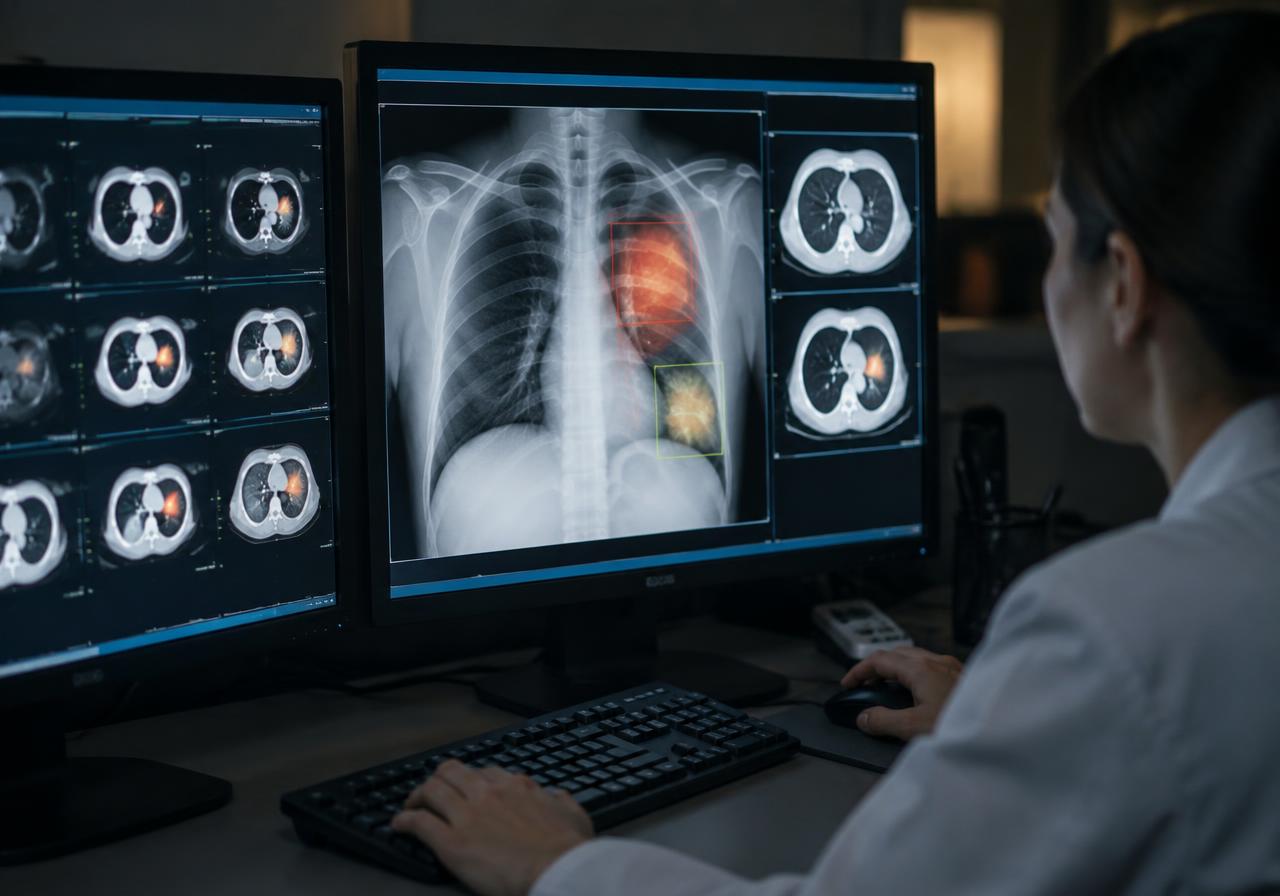
- AI in Medical Imaging & Radiology
- AI in Cardiology
- AI in Oncology
- AI in Clinical Practice
- AI in Medical Research
- AI in Emergency Medicine
Safety, privacy and governance
- All practical training uses simulated, synthetic or safely de-identified educational material.
- Real patient-identifiable information is never requested, entered or stored in this programme.
- AI may support learning and professional workflows. AI does not replace clinical responsibility, professional judgement or institutional governance.
- Any AI output encountered in this programme is educational material for critique, not clinical advice.
- Education delivered by AI, governed by humans.
- AI may teach, explain, demonstrate, question, provide formative feedback and guide practice.
- Human academic governance remains responsible for high-stakes decisions, moderation, disputed assessment results, safeguarding, academic integrity escalation, clinical safety escalation and exceptions.
Ready to start?
Explore the programme or begin your application.
Entry and admission requirements
- Doctors: MBBS or equivalent medical qualification, or current enrolment in an appropriate medical programme.
- Medical students: current enrolment in an undergraduate medical degree or equivalent healthcare programme.
- Basic computer and internet literacy.
- No prior programming or advanced mathematics required.
- Computer and reliable internet access recommended.
Required documents
Documents expected for admissions review, subject to the University's admissions requirements. You upload them securely in your applicant account; missing documents can be requested by admissions after you apply.
- Government-issued identity document — CNIC, passport, driving licence or another government-issued ID.
- Proof of highest / last qualification — Degree or qualification evidence, as applicable.
- Transcript or mark sheet — Where applicable.
- Recent photograph — Where applicable.
ICS AI for Healthcare Professionals
Early Bird: Rs. 75,000/- · Regular Fee: Rs. 140,000/-
First 50 students who complete payment and formal enrolment.
Questions? Contact the admissions team.