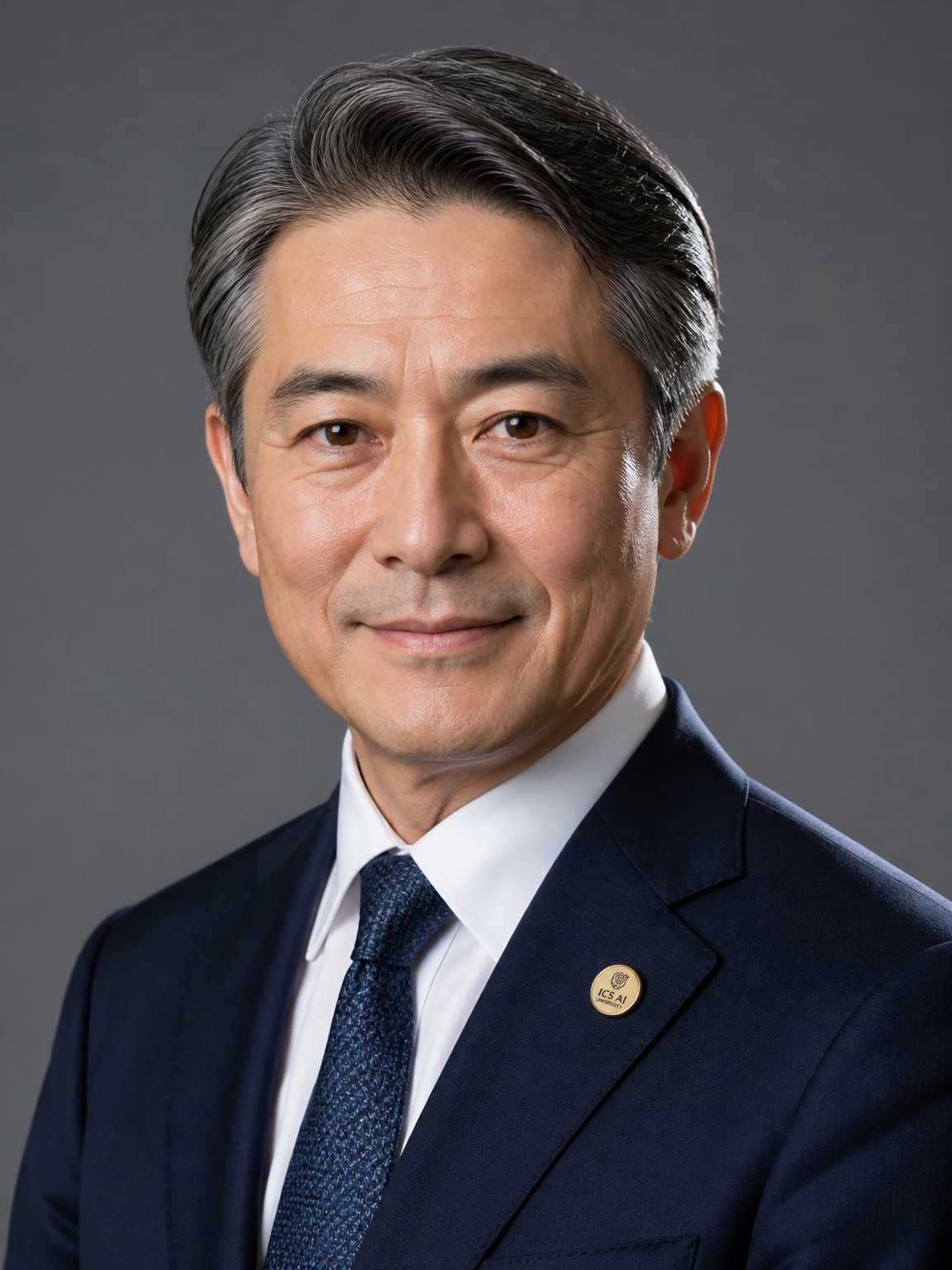
Prof. Dr. Kenji Watanabe
Dean, School of Engineering (Dean, School of Engineering)
Office of the Dean, School of Engineering
ICS AI University
“Engineering serves humanity when precision, innovation and sustainability advance together in service of society.”
About
About Prof. Dr. Kenji Watanabe
Prof. Dr. Kenji Watanabe is Dean of the School of Engineering at ICS AI University, where he provides strategic leadership across engineering education, applied research, industrial partnerships, innovation, entrepreneurship and technological advancement. He is an internationally respected engineer, researcher, innovator and academic leader with more than twenty-seven years of experience spanning advanced engineering, intelligent systems, robotics, smart manufacturing and sustainable technology.
Born and educated in Japan, Prof. Watanabe read Mechanical Engineering at Tohoku University, graduating with distinction and receiving early recognition for excellence in precision engineering, thermodynamics and mechanical design. He subsequently pursued a Master of Engineering in Robotics & Intelligent Systems at Kyoto University, where he specialised in autonomous mobile robotics, intelligent control and human-robot interaction, and contributed to some of Japan's earliest programmes on collaborative industrial robotics.
He completed his Doctor of Philosophy (Ph.D.) in Mechanical Engineering at The University of Tokyo, with a doctoral thesis on intelligent control architectures for high-precision industrial robots operating in dynamic manufacturing environments. His doctoral research received national recognition and laid the foundation for a career-long line of scholarship on autonomous systems, mechatronics and smart manufacturing. He was subsequently appointed Postdoctoral Research Fellow at the Massachusetts Institute of Technology (MIT), where he worked at the intersection of mechanical engineering, computer science and advanced manufacturing, and later completed the Executive Leadership Programme in Engineering Innovation & Technology Management at Stanford University.
Over the course of his career, Prof. Watanabe has held academic and advisory appointments at leading institutions across Asia, North America and Europe, including visiting professorships and research collaborations at MIT, Stanford, ETH Zürich, the Technical University of Munich, Imperial College London, the National University of Singapore and KAIST. He has served as principal investigator, advisor and technical expert to national engineering councils, ministries of industry, standards bodies and multinational manufacturers on matters of industrial robotics, smart factory transformation, sustainable manufacturing and engineering workforce development.
As an engineer and innovator, Prof. Watanabe has contributed to landmark industrial programmes and technology transfer initiatives covering autonomous production lines, digital twin platforms, collaborative robotics, embedded control systems and sustainable industrial technologies. He has worked closely with leading Japanese, European and North American manufacturers on the transition to Industry 4.0 and beyond, translating rigorous engineering science into deployable systems that improve productivity, safety, quality and sustainability.
His scholarship sits at the intersection of mechanical engineering, robotics, intelligent systems and sustainable industrial technology. He has authored more than 190 peer-reviewed publications, fifteen books and over forty-five book chapters, and has delivered more than one hundred and eight invited keynotes at premier venues including the IEEE International Conference on Robotics and Automation (ICRA), the International Conference on Intelligent Robots and Systems (IROS), the CIRP General Assembly and the World Manufacturing Forum. His scholarship has attracted more than 31,200 citations with an h-index of 81.
As principal investigator, he has led fifty-two research projects and secured more than twenty-six international grants from the Japan Society for the Promotion of Science, the New Energy and Industrial Technology Development Organization (NEDO), the European Commission's Horizon programmes, the U.S. National Science Foundation and international industrial consortia. His applied research has informed national robotics strategies, smart-manufacturing roadmaps and engineering curricula, and has produced technologies now in use across automotive, aerospace, semiconductor, energy and healthcare industries.
Prof. Watanabe has been a leading voice in the responsible advancement of intelligent engineering systems. He has contributed to international frameworks for human-robot collaboration, functional safety in autonomous systems, ethical automation in the workplace, and sustainable industrial engineering. He writes and speaks widely on the future of engineering in an era of artificial intelligence, the role of digital twins in industrial transformation, and the responsibility of engineers to design for resilience, sustainability and human wellbeing.
As an educator, Prof. Watanabe is deeply committed to student mentorship and doctoral supervision. He has supervised more than fifty-eight doctoral candidates and mentored hundreds of engineering students, junior researchers and early-career engineers, many of whom now lead research groups, industrial laboratories, technology companies and engineering faculties around the world. His teaching portfolio spans mechanical engineering, robotics, industrial automation, smart manufacturing, mechatronics, engineering design, artificial intelligence for engineering, engineering project management, research methodology and doctoral research seminars.
His leadership philosophy is anchored in academic excellence, engineering rigour, industrial relevance, interdisciplinary collaboration and international engagement. He believes that a modern school of engineering must combine deep disciplinary expertise with fluency in artificial intelligence, data and systems thinking, preparing graduates who can design, build and lead the intelligent infrastructure, sustainable industries and responsible technologies that societies will depend upon. Under his leadership, the School of Engineering is expanding its laboratories, deepening partnerships with global industry, strengthening accreditation with leading international engineering bodies, and cultivating an internationally connected community of engineers, researchers and innovators.
Prof. Watanabe is a Fellow of the Institute of Electrical and Electronics Engineers (IEEE) and a Fellow of the American Society of Mechanical Engineers (ASME). He is a member of the Institution of Engineering and Technology (IET), the International Federation of Robotics (IFR) and the Japan Society of Mechanical Engineers (JSME). He serves on international advisory boards, editorial boards of leading engineering journals, and accreditation panels, and continues to advise governments, industries and universities on engineering education, industrial innovation and the responsible advancement of intelligent systems.
His vision for the School of Engineering is to establish it as a globally recognised centre for engineering education, applied research and technological innovation — educating globally competent engineers capable of solving complex societal challenges through innovation, sustainability and responsible engineering.
Areas of Expertise
Fields of leadership and scholarship
Leadership Philosophy
Guiding principle
Engineering serves humanity when precision, innovation and sustainability advance together in service of society.
Academic Vision
A future-ready university
Research Interests
Active lines of inquiry
Industrial Robotics
Autonomous Systems
Smart Factories
Digital Manufacturing
Mechatronics
Embedded Systems
AI-driven Engineering
Intelligent Control Systems
Human-Robot Collaboration
Advanced Manufacturing
Engineering Simulation
Sustainable Industrial Technologies
Current Responsibilities
Executive portfolio
Strategic Leadership
Provides strategic academic leadership for the School of Engineering.
Academic Strategy
Develops and executes the School's long-term academic and research strategy.
Engineering Laboratories
Expands engineering laboratories and shared research infrastructure across the School.
Industrial Collaboration
Strengthens collaboration with leading industry partners and technology companies worldwide.
Accreditation
Leads engineering accreditation readiness with international engineering and quality-assurance bodies.
Innovation & Entrepreneurship
Develops innovation, technology transfer and entrepreneurship programmes across engineering disciplines.
Faculty Development
Supports faculty recruitment, mentorship and academic career development.
International Partnerships
Strengthens international engineering partnerships with universities, laboratories and industrial consortia.
Interdisciplinary Research
Promotes interdisciplinary engineering research across AI, data, systems and sustainability.
Graduate Employability
Advances graduate employability, professional pathways and alumni engagement.
International Reputation
Enhances the international reputation of the School through scholarship, partnerships and public leadership.
Coming Soon
Future-ready extensions
Reserved placeholders so this profile scales without redesign.
Dean's Welcome
SoonOfficial welcome from the Dean of the School of Engineering — coming soon.
Annual Dean's Address
SoonAnnual academic address from the Dean — coming soon.
Office Hours
SoonDean's office hours — Monday to Friday, 09:00–17:00.
Book Appointment
SoonBook an appointment with the Dean's Office — coming soon.
Research Portfolio
SoonSelected publications, books and keynotes — coming soon.
Doctoral Supervision
SoonCurrent and past doctoral supervisions — coming soon.